
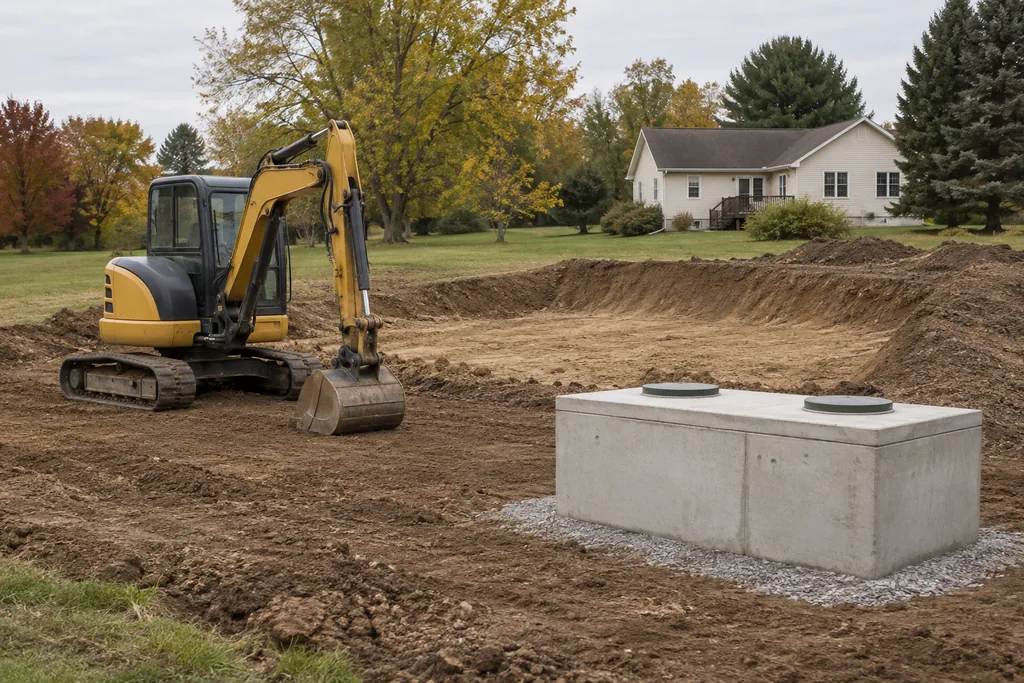
Confirm what must be replaced
A system showing problems is not automatically a replacement case. Inspection determines scope. Backups, gurgling, slow drains, odors or wet ground merit prompt assessment, but no single symptom identifies the failed component.
Inspection scope can include records, tank and component condition, filters, pumps and drainfield observations. Findings may support a focused repair, a component replacement such as a pump, or full system replacement.
Existing-system information matters
What already exists on the property shapes the work. County septic information includes a septic lookup request, and permit drawings plus service records can help identify existing components and prepare for a site visit. Records are not a guarantee of current condition.
- Records: lookup request results, permit drawings and service paperwork.
- Recent reports: any inspection, pumping, repair or service documentation on the existing system.
- Property layout: tank and drainfield locations, driveways, outbuildings, wells, setbacks and planned changes that affect access or site suitability.
- Household use: occupancy, water use and recent changes that may affect performance.
- Site conditions: soil, slope, drainage and space available for work.
- Known history: past repairs, replacements or adjustments, even if details are incomplete.
- An unknown last-pumping date is simply unknown. It does not by itself prove that maintenance is overdue.
Approval and site options
Elkhart County reviews onsite system installation. Repair and replacement procedure differs from new construction, so confirm project scope with the Elkhart County Health Department.
Site conditions and jurisdiction drive system selection. Conventional, chamber, mound and aerobic designs differ, and pumps may serve several designs. Local approval is not implied by a national example. Confirm suitability before comparing proposals.
Expect county review to begin with the existing system and the site. Ask what soil evaluation is needed, what drawing or application is required, what the permit covers, and whether the work is treated as repair or replacement.
Compare complete replacement proposals
Use the same questions for every written proposal so scopes are comparable. These are questions to ask, not a universal mandatory list; local requirements and site conditions determine what applies.
| Item to clarify | Question to ask |
|---|---|
| Removal and abandonment | Will the existing tank or components be removed, filled or abandoned, and what does that include? |
| New components | What tank, drainfield, pumps, controls and other components are included by type and function? |
| Site work | What excavation, soil work and access protection is included? |
| Site restoration | What grading, seed or surface restoration is included, and what is left as-is? |
| Permits and approvals | Who handles the county application, drawing and inspection coordination? |
| Exclusions | What is explicitly not included, and how are changed conditions handled? |
| Inspection and testing | What verification or testing is included before the work is considered complete? |
| Aftercare | What care, maintenance or monitoring guidance is provided for the new system? |
Planning the next decision
Replacement is one option among several. Repair may be appropriate when inspection identifies a limited issue. Cost depends on site conditions, scope, access and county requirements, so compare written quotes by scope rather than a single figure. If findings are not clear-cut, work through the repair-or-replace comparison; the inspection page explains what an evaluation covers.