
Budgeting references before you request a quote
EPA gives a national $250–$500 reference for routine septic maintenance. It is a budgeting guide, not an Elkhart County pump-out quote or a price for a particular tank size.
A Southern Indiana operator advertises pump-outs from $300 for a standard 1,000-gallon tank in its market. It is a secondary, non-local example and not an offer from this website.
Your written quote should identify tank capacity, access, disposal, and extra tasks. Compare included work before comparing the total.
Price references: EPA: why maintain your septic system — national cost context · Quick Pump and Clean: Southern Indiana pumping price example
Details to compare side by side
Line up quotes with the same questions. A lower number can mean less scope rather than a better rate.
| Quote question | Why it matters |
|---|---|
| Tank capacity and number of tanks | A larger tank or multiple tanks may hold more material and take longer to service. |
| Access, lid locating, and riser needs | A buried or unmarked lid may require locating, digging, or riser work. |
| Excavation and repair beyond normal access | Extra digging, damaged lids, or broken components change labor and disposal scope. |
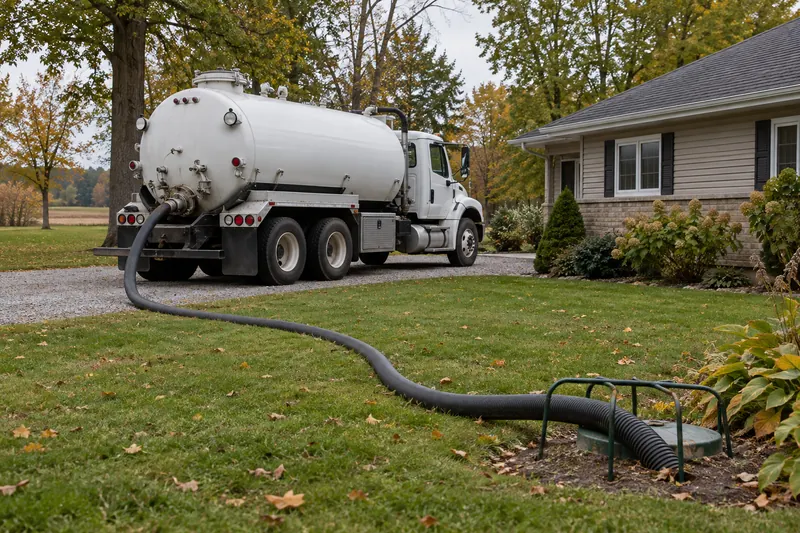
| Travel, parking, and hose reach | Distance from the truck to the tank can add hose sections, staging, and time. |
| Disposal and any extra work | Where removed material is taken and any added task affect the written total. |
Routine maintenance and problem calls
A routine pumping visit targets accumulated tank material on a maintenance interval. A problem call begins with symptoms such as backups, gurgling, slow drains, odors or wet ground. None alone proves which component failed; avoid contact with sewage and contact a qualified professional promptly.
Compare written scope, not only a starting figure. A visit with locating, assessment and disposal differs from a narrow pump-out.
A checklist for requesting prices
Use the same request format for each provider and keep replies side by side. A written total with clear inclusions is easier to compare than a verbal range.
- Property location and best access point for a truck.
- Number of tanks and known capacity, if available from permit drawings or service records.
- Lid status: exposed, riser present, or buried and needing locating.
- Recent symptoms such as backups, gurgling, slow drains, odors, or wet ground.
- Requested service: routine pumping, problem assessment, or another task.
- What the price includes: labor, equipment, hose reach, disposal, and cleanup.
- Exclusions such as excavation, repairs, riser work, or additional visits.
- Disposal method and location used for removed material.
- Whether a written scope and total can be provided before work begins.
- What could change the price, and how changes are approved.
Permit fees are a different category
County construction and repair permit fees are separate from contractor service charges. If work involves a system change, confirm requirements with the Elkhart County Health Department.