
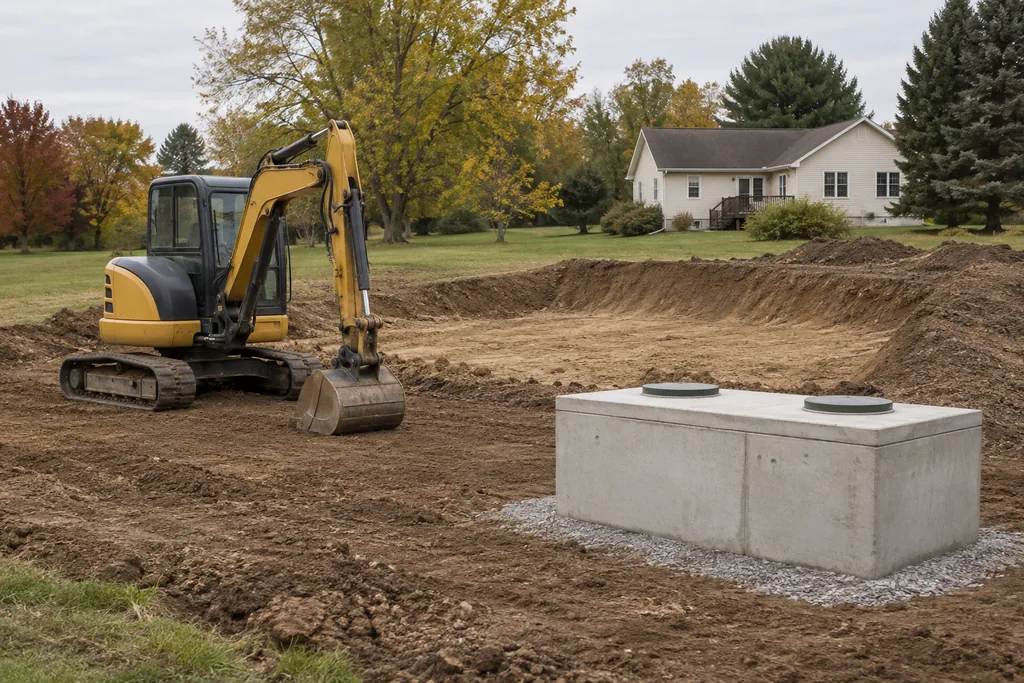
Price the approved scope
A new onsite system is site-priced because the approved design depends on soil evaluation, property layout, treatment needs and county review.
Repair and replacement follow a different procedure; confirm the project-specific scope with Elkhart County Health Department.
For broad context, EPA describes repairing or replacing a malfunctioning conventional system at roughly $5,000–$15,000; alternatives may cost more. That is a national repair/replacement comparison, not a new-installation range, Elkhart rate or quote. A new-system price depends on the approved scope.
Price references: EPA: why maintain your septic system — national cost context
Compare what each proposal includes
Use this as a question sheet. A missing line is not always wrong, but you should know whether another party handles it.
| Scope item | What to ask | Who is responsible |
|---|---|---|
| Evaluation and design | Is the soil evaluation, site plan and system design included or billed separately? | Contractor, designer or owner |
| Components | Which tank, pump, controls or treatment components are specified by make and model? | Contractor |
| Excavation | Are digging, bedding, backfill and spoil handling included? | Contractor |
| Electrical | If pumps or controls are needed, who arranges the licensed electrical work and its permit? | Contractor or separate trade |
| County fees | Are permit and review fees listed as a separate pass-through line? | Owner or contractor |
| Removal or abandonment | For replacement, is removing or abandoning the old tank included? | Contractor |
| Restoration | Does the quote include topsoil, seeding, driveway or lawn repair? | Contractor |
New work versus replacement
New installation and replacement can share components but rarely share site conditions. A replacement begins with existing components, an established drainfield area, landscaping and records that may not match what is underground. Those conditions need assessment rather than a simple multiplier on a new-build figure.
Where records exist, county septic information includes a lookup request, and permit drawings or service records can help identify existing components. Records are a starting point, not a current-condition guarantee. A qualified professional should assess the site and available treatment options before a proposal is priced.
- New installation: evaluate the proposed site, design and county requirements.
- Replacement: existing components and site constraints must be assessed first.
- Treatment options: conventional, chamber, mound or aerobic designs depend on site conditions and local approval. Pumps may serve several designs.
Separate government fees from contractor charges
County review and permit fees are set by government, not contractor markup. Ask for them as a separate line so you can see the public fee versus labor, equipment and materials.
Current fee amounts and the local review process are on the permits and records page. When ready, start a property-specific inquiry on the contact page.
Questions before choosing a proposal
Take these questions into every conversation and ask for answers in writing. A clear proposal explains what is included, what is excluded and how changes are handled.
- What is excluded from this price, and what would trigger a change order?
- How are changes priced and approved before work continues?
- Who pulls the permit and who is responsible for inspection requirements?
- Is the design based on a current soil evaluation for this property?
- What is the sequence of work, and who restores the site afterward?
- What warranty or workmanship terms are offered in writing?
- Can I see the approved scope next to the itemized quote before signing?