
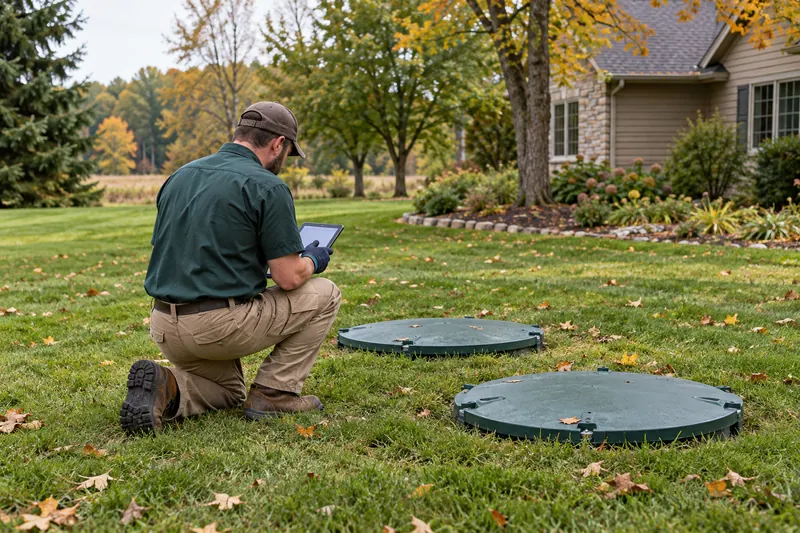
Agree on the inspection purpose
Routine inspection checks the tank and accessible components. Ask whether drainfield observations and maintenance records are included.
A septic inspection should establish the observed condition of accessible components, identify visible problems, document what could not be examined, and recommend next steps. Scope determines what is included.
If you have backups, gurgling, slow drains, odor or wet ground, the purpose is to narrow possibilities and recommend follow-up. Avoid contact with sewage and arrange qualified help promptly.
For a property purchase, gather records and confirm transaction requirements with your real estate professional, attorney, lender or the county health department.
EPA describes professional inspection at least every three years and typical pumping every three to five years. Household use, tank size, measured solids and system type affect the interval. Inspection and pumping serve different purposes.
Records to gather first
Records help an inspector or service professional find the system and prepare. They do not replace a current condition assessment.
- Prior permit or installation drawing. Locate any approval or as-built drawing from Elkhart County. The county maintains septic records and a lookup request process.
- Maintenance records. Keep notes on past service visits, filter cleaning, pump checks and other work.
- Pumping records. Gather dates and hauler notes if available. If the last pumping date is unknown, mark it unknown rather than treating it as proof of overdue maintenance.
- System type information. Conventional tank-and-drainfield, mound, drip and mechanical alternative systems have different service needs. Mechanical alternatives generally need more frequent checks.
- Household details. Number of residents, daily water use and recent occupancy changes help interpret the records.
- Site notes. Beds, driveways, outbuildings or landscaping over system components can affect access and how much can be examined.
Ask what will actually be inspected
Inspection scope can vary. Before scheduling, ask which items are included, whether any require additional equipment, and what the report will document. Camera inspection is not automatically part of every visit.
| Area | What is typically checked | Questions to ask |
|---|---|---|
| Records | Permit drawings, maintenance and pumping history, system type | Which records do you need, and how will you use them? |
| Tank | Accessible condition, inlet and outlet, baffles where visible, liquid level and solids indicators | Will you measure solids or check baffles? |
| Drainfield | Visible surface condition, wet or ponded areas, vegetation, signs of surfacing sewage | Are drainfield observations part of the basic scope? |
| Filter | Presence and cleanliness where the system has one | Is cleaning included or noted as a recommendation? |
| Pump and controls | Pump operation and alarm or control checks where accessible | Will the pump be exercised, and are controls included? |
| Camera | Pipe interiors where the scope calls for it | Is camera work included, optional or recommended after other findings? |
Read the report and exclusions
A useful report describes components examined, observations, exclusions and recommended next steps. Ask which areas could not be evaluated and whether further investigation is needed.
A slow drain or liquid in the tank is an observation to interpret, not a diagnosis by itself. The report should connect recommendations to findings and explain their limits.
Buying or selling a home
For a home purchase, gather records and confirm evaluation scope and transaction requirements early. The homebuyer guide covers those questions.
If findings point to maintenance or repair, use the relevant service guide to understand the next decision. A report and permit records provide different information; neither should be mistaken for the other.