
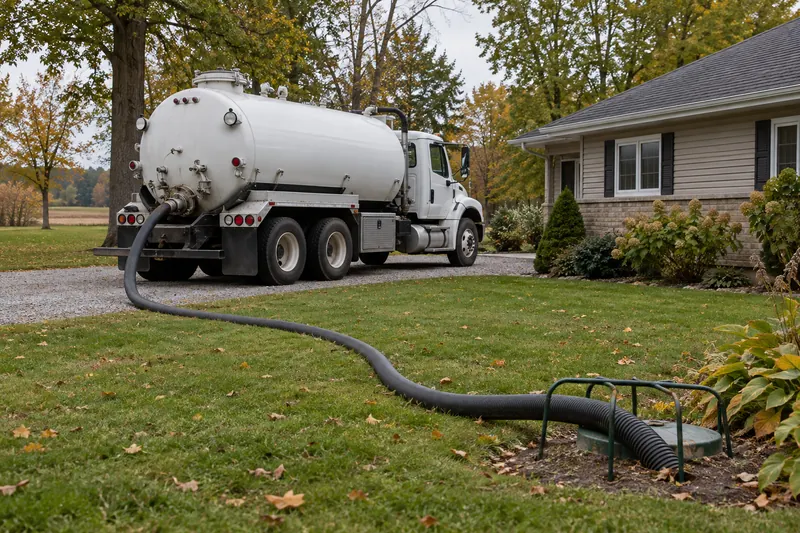
Pumping starts with the tank and its history
A conventional tank is a settling chamber. Solids sink as sludge, scum floats, and liquid effluent leaves for the drainfield. Pumping removes accumulated tank material. It does not restore soil that has stopped treating effluent or correct a failed component.
Routine pumping and problem diagnosis are different jobs. Symptoms alone do not establish which part failed; ask for evaluation rather than assume a pump-out will end the problem.
| Your situation | Useful starting point |
|---|---|
| Routine tank care | Discuss your pumping history and a suitable maintenance interval. |
| Backups, gurgling, slow drains, or wet ground | Request assessment of the system, not only a pump-out. |
| You want to know the system's condition | Ask what a professional inspection evaluates and documents. |
Prepare for a pumping visit
Gather information you already have. Leave tank opening, lid handling, and excavation to the provider. Never open, enter, or reach into a tank; sewage and confined spaces are serious hazards. Secure pets and clear the agreed work area.
- Location and access: tank or riser position, number of tanks, and size if known.
- Service history: last pumping or inspection, or note that the date is unknown.
- System type: conventional, chamber, mound or another design, and any pump, if documented.
- Household use: number of occupants and recent changes in water use.
- Symptoms: what happens, when it started, and whether it follows heavy water use.
- Truck access: driveway, gates, slope, soft ground, and parking constraints.
- Records: permit drawings, service receipts, and any existing access notes.
What to ask before accepting a quote
A price is easier to compare when you know what it covers. These scope questions belong in the written quote.
| Check | Ask the provider |
|---|---|
| Tank and capacity | How many tanks or compartments does the quote cover? |
| Access and digging | Is locating or exposing a buried lid included? |
| Truck and hose reach | Can the truck reach the tank from available parking? |
| Disposal | Does the total include transport and disposal? |
| Inspection and extras | What is checked, what is excluded, and how are changes approved? |
Choose a maintenance interval
EPA describes typical household pumping every 3–5 years and professional inspection at least every 3 years. These are qualified general guides, not a fixed schedule. Household use, tank size, measured solids, and system type change the interval; mechanical systems generally need more frequent attention.
Mention missing records when arranging service so the provider can factor them in.
When the problem needs more than pumping
If problems recur, or sewage surfaces, avoid contact and arrange a property-specific assessment. A form cannot diagnose the tank, pump, or drainfield from a description alone. A qualified professional can determine which component is involved and the next step.
Pumping addresses tank solids. Recurring backups or wet ground may point to a component that pumping will not correct.